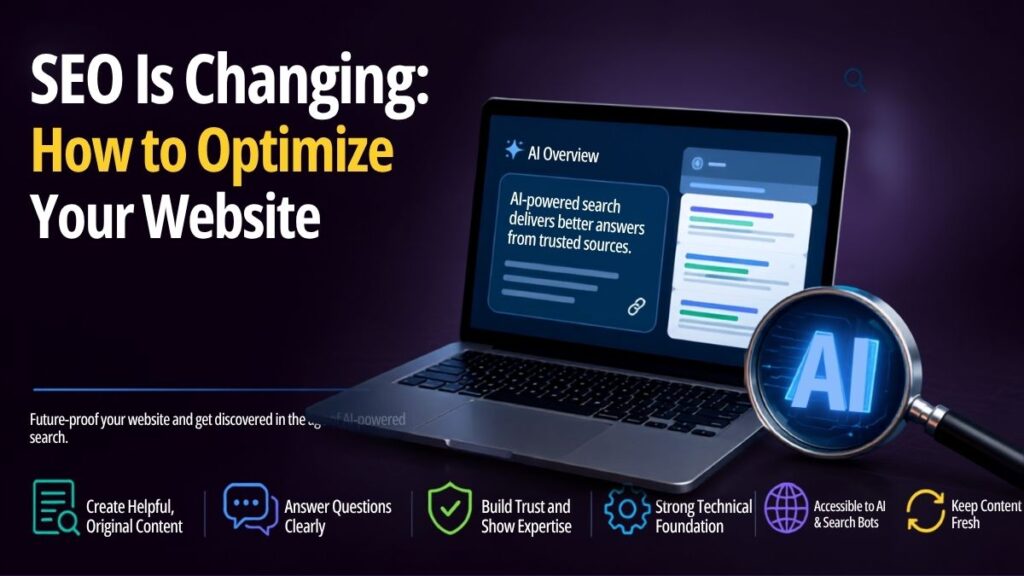
SEO is changing. For many years, businesses focused on ranking their websites on the first page of Google. The goal was simple: choose the right keywords, create content, build backlinks, and improve rankings.
But search is becoming more intelligent.
Today, people are increasingly asking questions in a natural, conversational way. Instead of typing a few keywords into Google, they may ask a complete question and expect an AI-powered answer.
Google is developing AI-powered experiences such as AI Overviews and AI Mode, while ChatGPT can search the web and provide answers with links to relevant sources.
This means businesses need to think beyond traditional SEO.
What Is AI Search?
Traditional search engines usually provide a list of web pages for a user’s query.
AI search can go a step further. It can understand the meaning behind a question, find information from different sources, summarize the information and provide a conversational answer.
For example, instead of searching:
“digital marketing services”
a user might ask:
“What digital marketing services does a small business need to get more customers online?”
AI-powered search can understand the intent behind the question and provide a more detailed response.
This creates a new opportunity for businesses: your website content needs to become useful enough for AI systems to understand, trust and potentially reference.
Why Traditional SEO Alone Is Not Enough
Traditional SEO is still extremely important. Google continues to recommend established SEO best practices for visibility in its generative AI search experiences.
However, simply repeating a keyword many times is no longer a good strategy.
AI-powered search looks at the overall meaning and usefulness of content.
For example, a weak article might say:
“Digital marketing is important. Digital marketing helps businesses. Digital marketing services are useful.”
A stronger article could explain:
- What digital marketing is
- Which channels businesses should use
- How each channel works
- What mistakes businesses should avoid
- How to measure results
- Real examples and practical recommendations
The second type of content provides much more value to both users and search systems.
7 Ways to Optimize Your Website for Google AI and ChatGPT Search
1. Create Helpful, Original Content
The foundation of AI-friendly SEO is high-quality content.
Don’t create articles simply because you want to target a keyword.
Instead, ask:
“What problem is my customer trying to solve?”
Then create a complete answer.
For example, if you provide digital marketing services, don’t only publish an article titled “Digital Marketing Services.”
Create useful content such as:
- How to get more customers from Google
- How SEO helps small businesses
- How to create a digital marketing strategy
- Common social media marketing mistakes
- How AI is changing digital marketing
The more useful your content is, the more opportunities you have to be discovered.
2. Answer Questions Clearly
People ask search engines questions.
Your content should answer those questions directly.
Use headings such as:
What is SEO?
How does SEO help small businesses?
How much does digital marketing cost?
How can I get more customers online?
Give a clear answer near the beginning of each section and then explain the topic in more detail.
This makes your content easier for humans to read and easier for search systems to understand.
3. Use Natural and Conversational Language
AI search understands conversational queries.
Therefore, don’t write content that sounds unnatural simply to include keywords.
Instead of:
“Best digital marketing agency services digital marketing SEO services business marketing”
write naturally:
“A small business can use SEO, social media marketing, content marketing and Google Business Profile optimization to improve its online visibility.”
Use keywords naturally where they make sense.
Your first priority should always be helping the reader.
4. Build Trust and Demonstrate Expertise
AI search needs reliable information.
Your website should clearly communicate who you are and what you know.
Consider adding:
- An About Us page
- Author information
- Contact information
- Client testimonials
- Case studies
- Examples of your work
- Experience and qualifications
- Links to reliable sources when appropriate
If you are writing about digital marketing, demonstrate your knowledge through practical examples and useful advice.
Don’t simply publish generic AI-generated articles.
Add your own experience, opinions, examples and insights.
5. Make Your Website Technically Strong
Content is important, but technical SEO still matters.
Make sure your website:
- Loads quickly
- Works well on mobile devices
- Uses HTTPS
- Has a logical website structure
- Uses descriptive page titles
- Uses proper headings
- Has useful internal links
- Can be crawled by search engines
- Has an XML sitemap
- Avoids unnecessary technical errors
A website still needs to be accessible and understandable to search systems.
6. Keep Your Content Fresh
AI search users want useful and current information.
Old content can lose its value when statistics, tools, strategies or industry practices change.
Review important blog posts regularly.
Update:
- Statistics
- Examples
- Screenshots
- Tools
- Links
- Strategies
- Industry information
Don’t simply change the publication date.
Actually improve the content.
What About Keywords?
Keywords are still important, but the way we use them is changing.
Instead of focusing on one keyword, think about a topic and related questions.
For example, instead of targeting only:
“SEO services”
you could create content around:
- What are SEO services?
- How does SEO work?
- Why does a business need SEO?
- How long does SEO take?
- How much does SEO cost?
- How can local businesses improve SEO?
- What is AI SEO?
This creates a stronger topical relationship across your website.
The Future of SEO Is About Being the Best Answer
The biggest change in SEO is not simply about algorithms.
It is about how people search for information.
People increasingly want direct answers rather than a long list of websites.
This means businesses should ask themselves:
“If an AI system had to recommend my business to a customer, would my website provide enough useful information and evidence to support that recommendation?”
If the answer is yes, you are moving in the right direction.
Final Thoughts
Create useful content. Answer real customer questions. Demonstrate expertise. Make your website technically strong. Keep information updated. And make your content accessible to search crawlers.
Write for your audience first—and make your website easy for search engines and AI systems to understand.
That is the future of SEO.
Ready to Improve Your Online Visibility?
If you want to build a stronger SEO and digital marketing strategy for your business and explore how the right combination of SEO, content and digital marketing can help your business grow online.